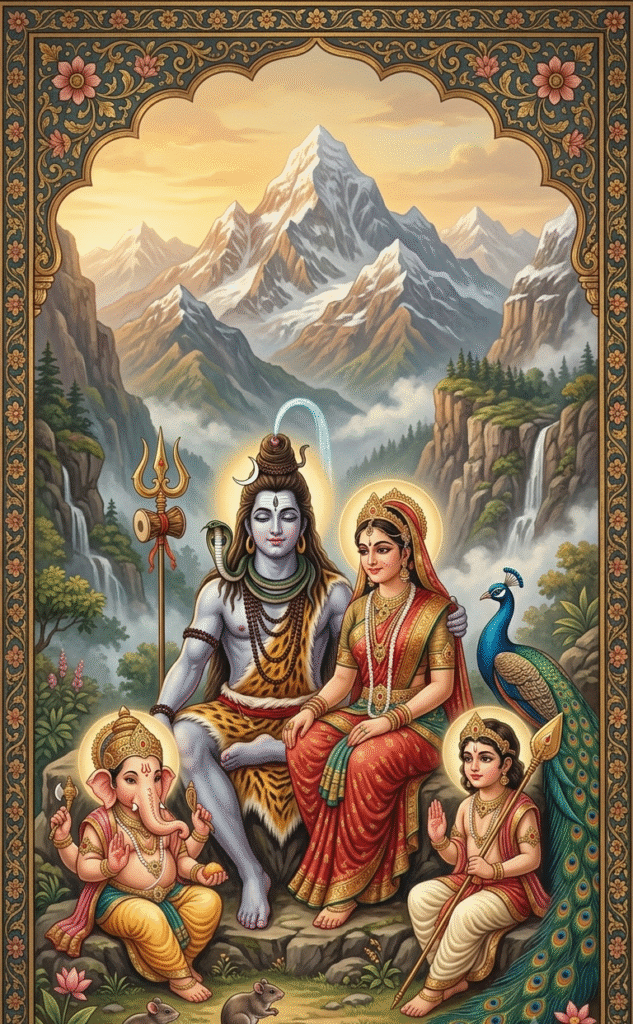
Shiva wears a snake around his neck. His son Ganesha rides a mouse. His other son, Kartikeya, rides a peacock. And somehow, this is one family.
It is such a familiar image in Hindu mythology that we rarely stop to question how unusual it actually is. A snake and a mouse are natural enemies, while peacocks are known to prey on snakes. Yet the animals associated with Shiva, Ganesha and Kartikeya appear together within the same divine family. There is something almost amusing about it when you look at it from a purely natural perspective: the snake, the mouse and the peacock probably wouldn’t make the most peaceful neighbourhood. But perhaps the contrast is what makes the imagery so interesting.
The animals associated with Hindu deities are not merely there for decoration. Their presence is often connected with the deity’s stories, attributes and symbolism. Shiva’s association with the serpent is deeply woven into his iconography; Ganesha is traditionally depicted with the mouse or rat, known as the mūṣaka, as his vāhana or vehicle; and Kartikeya, also known as Murugan or Skanda, is famously associated with the peacock. These traditions have developed across centuries and across different regions, so their meanings are not necessarily reducible to one single explanation. Yet when we place these three animals side by side, an intriguing thought emerges.
They are very different. They may even be natural enemies. And yet, they are family.
A family does not have to make sense to everyone
Perhaps that is what makes this more than an interesting detail from Hindu iconography. It is also a surprisingly familiar picture of family life.
We often imagine harmony as everyone getting along because everyone is similar. We like the idea of families where people share the same values, interests and personalities. But anyone who has actually lived in a family knows that this is rarely how it works. One person can be intensely practical while another is endlessly imaginative. One can love routine while another cannot stay in the same place for five minutes. One may be outspoken and argumentative, while another would rather remain silent. Even when people grow up under the same roof, they can become remarkably different people.
And that difference does not necessarily weaken a family.
In fact, sometimes it is precisely what makes a family a family. You do not choose your sibling because they have the same personality as you. You do not become close to a parent because they agree with every decision you make. Families are not built on everyone being a perfect match. They are built through relationships that survive differences.
That is what makes the image of Shiva’s family so fascinating. The snake does not have to stop being a snake. The mouse does not have to become like the snake. The peacock does not have to give up what makes it a peacock. Their differences remain, and yet they occupy the same symbolic family.
The snake, the mouse and the peacock
Look at the three animals individually and the contrast becomes even more striking.
The snake is one of the most recognisable symbols associated with Shiva. Serpents appear repeatedly in Shiva’s iconography, including the famous serpent around his neck. Ganesha, meanwhile, is commonly depicted with a mouse or rat as his vāhana. The pairing itself has generated many traditional interpretations, particularly because the tiny mouse seems almost comically disproportionate to the elephant-headed deity it carries. [Read: why does Ganesha have one tusk ]
Then there is Kartikeya, whose vāhana is the peacock. The peacock is visually magnificent, colourful and unmistakable, making it one of the most distinctive associations in Hindu religious imagery.
Now put the three together.
The snake is associated with Shiva. The mouse is associated with Ganesha. The peacock is associated with Kartikeya. And in nature, these animals have relationships that are anything but peaceful. A snake may prey upon rodents, while a peacock can attack or eat snakes.
The mythology does not need to turn this into a literal zoological family tree. That is not really the point. The striking part is the coexistence of symbols that, outside the divine setting, might represent conflict or predation.
Perhaps the imagery is reminding us of something that is easy to forget: coexistence does not require sameness.
We do not have to erase our differences
There is a tendency in modern conversations about relationships to treat differences as problems that must be solved. If two people disagree, we immediately ask who is right. If siblings have different personalities, we compare them. If family members choose different careers or lifestyles, we sometimes wonder why they cannot simply understand one another.
But perhaps the better question is not always, “How do we make everyone the same?”
It might be, “How do we remain connected even when we are different?”
That distinction matters.
Imagine if every member of a family had to behave identically for the family to remain united. There would be very little room for individuality. The quiet person would have to become loud. The adventurous person would have to become cautious. The ambitious person would have to want exactly what everyone else wants. The person who sees the world differently would constantly be asked to change.
That is not harmony. That is conformity.
Real harmony can be something much more difficult and much more beautiful: allowing differences to exist without allowing those differences to destroy the relationship.
Perhaps that is the lesson hidden in the picture
Of course, we should be careful not to claim that Hindu mythology has one definitive message saying, “the snake, mouse and peacock represent family differences.” Religious traditions are much more complex than that, and different symbols have different histories and interpretations.
But as a reflection inspired by the imagery, the idea is compelling.
Shiva’s family gives us a picture in which difference is impossible to miss. The animals associated with the members of the family are not alike. Some are natural antagonists. Yet the family itself remains one.
And perhaps that is why the image can feel strangely relevant even today.
Our families can contain people who disagree about almost everything. They can have different personalities, priorities, ambitions and ways of looking at life. They may irritate one another, misunderstand one another and occasionally drive one another completely crazy.
But none of that automatically cancels the relationship.
Sometimes, being family simply means learning that someone can be very different from you without being less important to you.
One family, despite everything
Maybe that is the part of this imagery worth carrying beyond mythology.
The snake does not need to become the mouse. The mouse does not need to become the peacock. The peacock does not need to become the snake. Their differences do not disappear in order for them to belong to the same family.
And perhaps our families can work the same way.
We do not have to agree on everything. We do not have to share the same personality. We do not have to make the same choices or see the world through exactly the same eyes. There will be differences, disagreements and sometimes even genuine conflict.
But difference and belonging are not opposites.
A family can contain people who are remarkably different and still remain a family.
Perhaps that is what makes this strange combination of a snake, a mouse and a peacock so memorable. What initially looks like a contradiction can become a reminder that unity does not mean uniformity.
Sometimes, despite all our differences, we are simply and beautifully one family.
