Look closely at an image or idol of Lord Ganesha and there is one detail that is easy to miss precisely because we have seen it so many times: one of his tusks is broken. Ganesha is traditionally depicted with an elephant’s head and two tusks, but one is usually shown shorter or broken. It is such a familiar part of his appearance that we rarely stop to ask why.
The answer, however, is not as simple as there being one universally accepted story. Hindu traditions contain several stories explaining Ganesha’s broken tusk, and each one gives the unusual feature a slightly different meaning. In one well-known story, the tusk is broken during a confrontation with Parashurama, while another popular tradition connects it to Ganesha’s role as the scribe of the Mahabharata.
Together, these stories help explain not only why Ganesha has one tusk, but also why he is known as Ekdant, the one-tusked deity.
What Does Ekdant Mean?
The name Ekdant, also written as Ekadanta or Ekadant, comes from Sanskrit. Eka means “one,” while danta refers to a tooth or tusk. The name therefore literally describes Ganesha as the one-tusked one.
Ekdant is one of the many names associated with Ganesha, and his broken tusk has become an important part of how he is represented in Hindu art and religious traditions. But the reason behind it changes depending on which traditional story you encounter.
That is what makes the question particularly interesting. Rather than having a single explanation, Ganesha’s missing tusk has gathered several stories around it over time.
The Story of Ganesha and Parashurama
One of the best-known explanations for Ganesha’s broken tusk involves Parashurama, the warrior sage who is traditionally regarded as an incarnation of Vishnu. According to this story, Parashurama once went to Mount Kailash to meet Lord Shiva, but Ganesha was guarding the entrance and refused to let him pass.
What began as an argument eventually turned into a confrontation. Parashurama, angered by Ganesha’s refusal to move aside, threw his powerful axe at him. The weapon was especially significant because it had been given to Parashurama by Shiva himself.
Ganesha recognized the connection between the weapon and his father. Rather than allowing the sacred weapon to be dishonoured, he accepted its blow, and the axe broke one of his tusks. From this point, the broken tusk became part of Ganesha’s appearance and helped give rise to his identity as Ekdant.
There is more to this story than simply explaining why a god has a broken tusk. Ganesha’s decision to accept the blow can be understood as an expression of respect for Shiva and his divine weapon. The broken tusk therefore becomes part of a larger story about Ganesha’s character, rather than merely being the result of a physical battle.
The Mahabharata and the Broken Tusk
Another extremely popular story gives the broken tusk a completely different origin. This version connects Ganesha with the Mahabharata and the sage Vyasa.
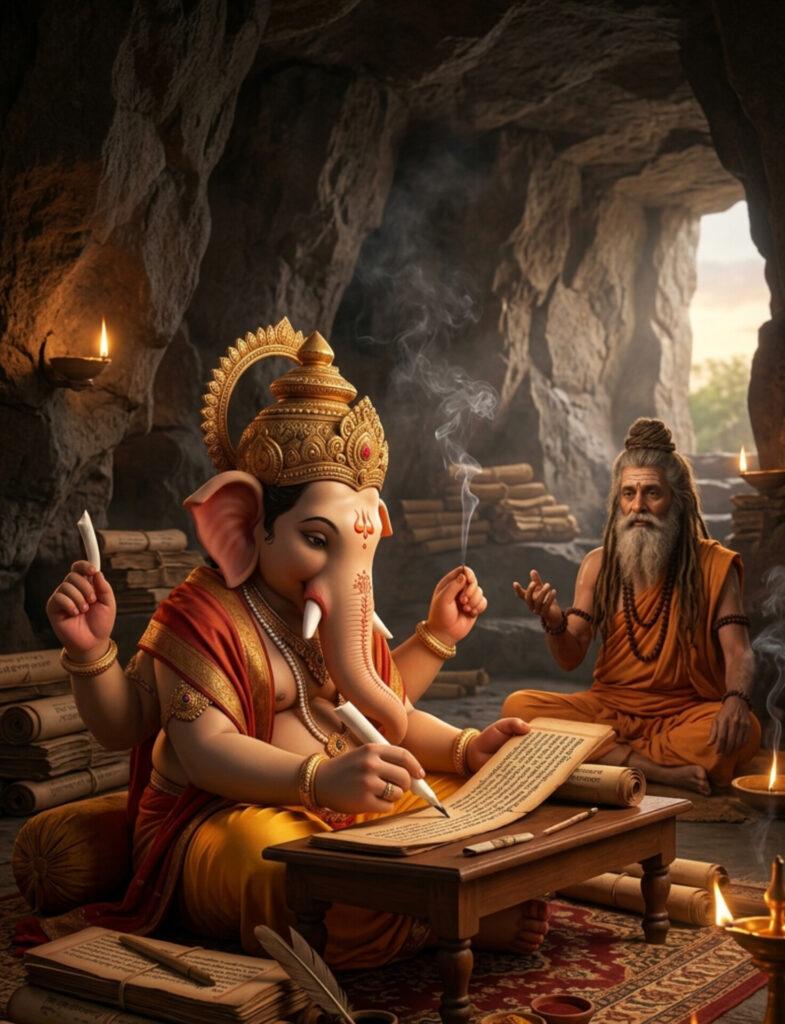
According to the later tradition, Vyasa wanted to dictate the enormous epic and needed a capable scribe to record his words. Ganesha agreed to write it down, but the arrangement came with an unusual condition: Vyasa would have to dictate continuously, without stopping.
Ganesha accepted the challenge, but he imposed a condition of his own. He would write only if he understood every verse before recording it. The two therefore began the task with Vyasa dictating and Ganesha writing.
At some point, Ganesha’s writing instrument broke. Instead of stopping the work, he broke off one of his own tusks and used it as a writing instrument. The story therefore transforms the broken tusk into a symbol of determination and sacrifice: Ganesha was willing to give up part of himself rather than allow the work to come to an end.
It is important to add a little context here. The familiar story of Ganesha serving as Vyasa’s scribe is a later tradition associated with the Mahabharata rather than a story found in the earliest surviving layers of the epic itself. Nevertheless, it became deeply established in Hindu tradition and is one of the most widely known explanations for Ganesha’s broken tusk.
Why Would a Broken Tusk Become a Symbol of Wisdom?
The Mahabharata story helps explain another important association of Ganesha: his connection with knowledge, learning and intellect.
If Ganesha broke his own tusk to continue writing, the object that made him look different became the very tool that allowed him to accomplish an important task. The story can therefore be read as a reminder that knowledge and meaningful work may require persistence, sacrifice and a willingness to overcome obstacles.
This interpretation fits naturally with Ganesha’s broader identity. He is traditionally invoked at the beginning of important undertakings and is associated with wisdom and the removal of obstacles. His broken tusk consequently becomes more than a physical characteristic; it can also represent the ability to continue despite an obstacle.
There is something particularly fitting about that symbolism. A broken object is not necessarily useless. In Ganesha’s story, the broken tusk acquires a new purpose.
So, Who Actually Broke Ganesha’s Tusk?
The answer depends on the tradition being followed. In the story involving Parashurama, the tusk is broken when Parashurama’s axe strikes Ganesha. In the Mahabharata tradition, Ganesha breaks the tusk himself so that he can continue writing.
These stories are sometimes presented as if one must be the correct version and the other must be wrong. But Hindu mythology has developed through a vast collection of texts, oral traditions, regional practices and retellings. Different traditions can preserve different explanations for the same symbol.
In this case, the stories even give the broken tusk different qualities. The Parashurama story highlights Ganesha’s relationship with Shiva and his willingness to respect his father’s weapon, while the Mahabharata story emphasizes determination, sacrifice and the pursuit of knowledge.
Why Are There So Many Stories About Ganesha?
One reason Hindu mythology is so fascinating is that familiar figures are rarely confined to a single story. Myths have been retold across centuries and in different regions, and details can evolve as stories move between texts and oral traditions.
Ganesha’s broken tusk is a good example of this process. A single visual feature became associated with several narratives, each giving devotees another way to understand the deity. Rather than making the symbol meaningless, the different stories have allowed it to accumulate layers of meaning.
The Meaning Behind Ekdant
The name Ekdant is therefore more than a description of Ganesha’s appearance. It points to a characteristic that has been woven into several stories about his strength, wisdom and relationship with other divine figures.
This also explains why you may hear different answers when you ask someone why Ganesha has one tusk. One person may immediately tell you about Parashurama, while another may tell you about the Mahabharata. Both stories have a long place in the traditions surrounding Ganesha.
His broken tusk also fits into a broader pattern in Hindu iconography, where physical features are often connected with stories and symbolic meanings. Ganesha’s elephant head, large ears, trunk, rounded belly and other attributes have all inspired interpretations, and the broken tusk is another example of mythology being incorporated directly into his visual identity.
Perhaps the most interesting part is that the tusk does not represent weakness. Ganesha is not remembered as the god with something missing. He is remembered as Ekdant, the one-tusked Ganesha.
The missing piece has become part of the identity.
A Small Detail With a Very Long Story
We often become so familiar with religious images that we stop questioning the details in front of us. Ganesha’s broken tusk is one of those details. It appears in countless idols, paintings and illustrations, yet behind that small feature lies a collection of stories about conflict, devotion, knowledge and sacrifice.
There may not be one single answer to the question of why Ganesha has one tusk. Instead, there are several traditional answers, each revealing something different about how Ganesha has been understood.
So the next time you see an image of Ganesha, look a little closer at his face. The broken tusk is not simply an unusual feature of an elephant-headed deity. It is a reminder that even the smallest detail in mythology can carry a story and sometimes, several stories at once.
